
Abstract
This paper aimed to elaborate Taufiq Rafat’s poem “Reflection” with the help of stylistic analysis. The method of this paper is qualitative and quantitative. Two type of data has been collected by the writer of this paper one type of data is primary data poem Reflection while another one is secondary data articles, other research paper and online website etc. This paper seens through the perspective of Lexical Level, Morphological Level, and Phonological Level. The author of this research paper also find out that the use of parts of speech Lexical Level the use of compounding and affixes Morphological Level and the repetition of vowel and consonant sound and rhyme Phonological Level. This elaboration or analysis is play important role in the understanding of readers. This analysis is also helpful in the revealing of the meaning of the poem.
Key Words
Style, Stylistics, Phonological, Lexical and Morphological
Introduction
What is Stylistic Analysis?
Stylistics is a branch of Applied Linguistics. Stylistic is bridge between linguistic and literature .Widdowson (1975) said that it is “the work of fictional discourse from a language orientation. According to Otanes.ms Stylistic is the practice of ideas form phonology and related to the field of study in the investigation and evaluation of parts of conversation within linguistic .The language learning of various styles chapman, According to Aminu (2015).A verbal attitude to the study of literary edition. Brumfit and Carter, (1997).Stylistic is the linguistic learning of a literary text; concerning the writer’s choices of words, tones and mode etc. Peter Barry define that Stylistic is the serious means which practices the approaches as well as results of skill of linguistics in the examination of literary text. If stylistic did not exist we would not be able to analyze any text. Stylistic is a technique of written explanation in which the importance of apartment is given to language Paul Simpson (1997). Moreover, Language concerned with theories try to encourage an objective practice of investigation and explanation through the literature object self-determining of an writer’s purpose Kumar, (1987).Verdonk (2002) point out that Stylistics as “the interpretation of individual appearance in verbal and the record of its aims and influence. Stylistics is actually Linguistics but in Linguistic we study language is general but in Stylistic we Study a specific domain of language which is Style.
Style
Style is derived since Latin term “elocution”
its means style and in Greek elocution means terminology .Style is rich word because it has various meaning in and outside of literature. Style is the study of certain creation of action in language practice, the usual and unusual both. Many years ago, for Aristotle, Cicero and Quintilian, (PP 47-50) ‘style’ was exposed as the arrangement of ideas. Swift supposed that style is correct words in exact spaces. The term ‘style’ remained approached to unlike kind of linguistic, such is the language of religion, or of lawful documents these diversities are well accepted as registers. Leech and short (2007) similarly evaluate style as the mode of the author to express meaning to the reader. Style is the complete view or tune of the author. It is also the improvement for poet, easiest, dramatist, novelist and for the learner. Aristotle presented that style is manner of a literary work. According to distinguish literary scholar M.A. Abrahams, style is defined as “the manner of linguistic expression in prose or verse.
Levels of Stylistic Analysis
Graphological Level
In Graphological Level we study the system of language writing. In graphology we study the physical shape of writing. Such as punctuation in the sentence, full stop, colon, semi colon, coma, hyphens, ellipses, capitalization, spacing and question mark etc.
Phonological Level
In Phonological Level we study the system of speech and sound. According to M.Tariq (2018) Ofuya has the opinions that Phonology is the study of the sound shapes. According to M.Tariq(2018) Lodge has the approaches that ?Phonology is the study of sound system of a language such As alliteration, consonance, assonance and rhyme scheme etc.
Grammatical Level
Grammatical Level concerned with the rules and regulation of language through which we can speak and write a language correctly. In this level we discuss the internal formation, structure of sentence and their function .Like parts of speech, noun, pronoun, clauses, phrases, verbs etc. Abbreviations (PTI, PM Etc.)
The lexical Level
Lexical Level is involved in the study of lexical items in a version, their distribution in relation to one another, and their meaning such as parts of speech.
Morphological Level
Morphological Level mentions the psychological system which involves in word creation that takes habitation in the attention. It show that in which way the words are formed, everywhere the created shape of words, what is the purpose of prefixes and suffixes in the creation of words, how. morphological devices include affixes and compounding.
Syntactic Level
Syntactic Study refers to the study of Syntactic function of different parts of speech. Syntactic functions such as nouns (as subjects, objects) adverbs as modifiers will be investigated.
Introduction of the Poet, Taufiq Rafat (1927-1998)
Taufiq Rafat is one of the famous Pakistani poets and writers. Taufiq Rafat became born right into a respectable, nicely-to-do own circle of relatives of Sialkot in 1927. He got knowledge form Dehra Dun, Aligarh and Lahore. Taufiq Rafat is considered as the pioneer of English language poetry and he used very simple and understandable language to express his thoughts, ideas and experiences in poetry. Most of his writing is influenced by other Pakistani writers and due to his concept of “Pakistani idiom” in English literature he is considered as the father of Pakistan idioms. Taufiq Rafat attempted many workshops about poetry which effected poets.
He used colloquial English in most of his works and many of his poems can be interpreted through many stylistic levels. His poetry is expected to be romantic and about nature. His verses present peaceful symbolisms which are full of creatures, season, individual, blossom, and trees as we have studied. The writer is completely mindful of his foundations and Pakistani town life, which includes in multitudinous sonnets. He remains in accordance with Shakespeare of England .Taufiq Rafat, the best Pakistani artist who worked in English. Rafat’s main effort the arrival of the monsoon: many composed poetries (1947-1978 (1985) was unforgettable things for Pakistani literature.
Taufiq Rafat and Elements Of Modernism In His Poetry
In Sialkot, Taufiq Rafat was born in 1927 into a reputable, well-off family group. Between 1982 and 1983, Rafat produced excellent translations of Punjabi poetry as well as numerous editions of Qadiryar's Puran Bhagat and Baba Bulleh Shah's works. His private collection Arrival of the Monsoon: The Collected Poems 1947–1978 was published in 1985 and received widespread praise. Unfortunately, Rafat had serious health issues during this time, especially after having strokes in 1977–1978. He was able to bounce back from these losses on a frequent basis, but he lost a lot of his electricity and ultimately made the decision to retire to a little farm he had purchased close to Bedian, Lahore. In spite of retreating more and more into self-imposed isolation due to later infection relapses that culminated in a string of strokes that left him partially paralyzed and unable to talk, he continued to write here and meet literary people with his usual love for life. He persisted heroically and with humor, nonetheless, until his passing in 1998. Later, a few of his most recent poems were published posthumously by Pakistan's Oxford University Press.
Poets of the modern era have developed fresh styles for poetry that deal with life, love, and death as themes. The phrase "contemporary-day" broadly refers to a variety of poets, movements, and stylistic trends from the twentieth and twenty-first centuries. Within the field of art, the term "contemporary" also encompasses a wide range. It refers to literary works published between 1914 and 1917, when World War I broke out, as well as to numerous experimentation with form and substance . Modernism is a perceived break with past traditions, according to the phrase. There are only a few poets whose works have been preserved from the past, yet they are responsible for inspiring modern poetry in the English-speaking globe. Specifically, they are American and British property. Additionally, a great deal was provided by a large number of poets from various areas of the industry.
In conclusion, it will no longer be wrong to classify Rafat's poetry as part of the modernist movement because Rafat's poetry is enhanced with modernist characteristics. In particular, the poem that was chosen for the current observance is enhanced with modernist characteristics.
Introduction to the Poem “Reflections” by Rafat
Early poems by Taufiq Raft were lyrical and descriptive, but as his career progressed, his major poems began to express a hardening of the heart. "Reflections" is not only one of Rafat's longest and most difficult poems, with significant philosophical undertones and symbolism, but it is also the most significant in a distinctly personal sense. At a pivotal point in Rafat's life, the poem was composed. He had a crippling stroke that rendered him bedridden for three years. His poetic concentration continued to be engaged while he began to recover from this physical paralysis. "Reflections" is the product of these three years of introspection. As such, it additionally marked his ‘healing’ with inside the poetic feel, returning to his writing after huge delay. The identify itself is alternatively philosophical, signifying, on the sole hand, the musings and mind of the poet as he slowly recovered at his farm and reread plenty of his favorite works from Eastern and Western literatures; on the alternative hand, in phrases of intertextuality, ‘reflecting’ sort of a mirror, severa scholarly references to Eastern and Western literatures, histories, mystical concept systems, etc. a number of the essential ones are as follows:
Yeats’s idea of the ‘gyres’ of records.
The Buddhist (conventional) cycle of the Gautama Story.
J. L. Lowes’ the Road to Xanadu: A Study with inside the Ways of the Imagination;
Bulled Shah and Sultan Bahu .
Basically, the themes of “Reflections” are 3, summed up thus:
. the thought of birth, death and rebirth connected to the herbal order as nicely because the lives
of people in the large cosmic panorama;
The dating among existence and artwork, as expressed through the human preference to preserve and supply an explanation for nature, the which suggests of lifestyles and different associated mysteries, so as to locate instructions for self-development and perfection;
The mystic apprehension of the artistic, poetic experience, as lived and felt within the bounds of diverse human traditions and rituals of all descriptions.
“Gangrene” and maximum of all “Reflections” . it's apparent from those poems that he isn't a sentimentalist; alternatively, he's the grasp of understatement who alternatively conveys his tragic imaginative and prescient of lifestyles with the financial system of expression. pertaining to his lengthy infection and vegetable lifestyles on bed, and later healing of fitness and creativity, he writes:
The long dry spell is over,
Waiting is ended. The paddy fields
Receive last monsoon showers
With a fierce gladness. (Rafat, Reflection).
Literature Review
Here in this section of the research study, the researcher has presented the review of other similar researches in the following paragraphs. This chapter aims to review the critical points of current study on a particular topic.
Roona, Ghazanfar and Maqbool (2022) have conducted their study on the same field in which they have stylistically analyzed a poem the Street of Nightingale by Daud Kamal. Their main focus in their research paper in the following levels of language: Lexical Level, Morphological Level, Pragmatic Level, Phonological, Semantic and Syntactic Level of the language used in the poem. Moreover, they have focused on the explanation and exploration of Stylistic as a branch of linguistic and its connection with the formation and construction of any literary text .They have also focused on how the structure and idea in poetry are being formed with the help of language levels. Apart from that, the researchers have analyzed the mood and the tone of the poem and described the modern touch and romantic life being portrayed in the very poem.
Another study has been conducted by Ali et al (2016) which focus on the Stylistic Analysis of one the Emily Dickson’s poems titled Hope is the Thing with Fathers. They are the view that it is a common process among all the researchers to unveil the meaning of figurative language being used in literary texts. In the analysis, they have worked upon Lexical, Phonological, and Grammatical and Graphological Level of language.
The Onset is a poem written by Robert Frost. The poem possesses multilayered meanings being analyzed by using various tools. The authors have analyzed Stylistic features of the poem through interpreting its diction, the imagery used in the poem and sound devices for the sake of elucidating the themes of the poem. Furthermore, the researchers have tried to point out the basic themes being used as a conflict between pessimism and optimism, life and death, and good and evil. The study Stylistic Analysis of the poem Onset have not touched other levels of language but the authors have just pointed out the following literary devices: imagery, symbolism, simile, metaphor, hyperbole and many sound devices such as alliteration, consonance, assonance and rhyming scheme etc. (Khan, Raffique & Sadiq, 2014)
Baatool et all (2016) has conducted her studies on the Stylistic Analysis of a verse titled Daffodils printed by a right well-known impractical writer William Wordsworth. Her Stylistic study is based on the following language levels: Graphological, Semantic, Phonological and Morphological. By analyzing these language levels, the author has tried to point out the conveyed meaning mentioning the sweet memories of the past. Moreover, she has focused on finding out the hidden meaning being used in the poem through literary devices. Her analysis of the poem Daffodils is also helpful in understanding the fundamental concept that how nature can give peace of mind to a depressed soul. Apart from that, the researcher has explored that how nature in the poetry is being affected by the social background of the poet and how figurative language increase the impact of poetry on reader’s mind.
Thomas Hardy’s poem titled During the
Wind and Rain has been analyzed in terms of stylistic features by Putri (2018) in which he has focused on the use of punctuation (Graphological Level) assonance, consonance, rhyme (Phonological Level) and the use of affixes and compounding (Morphological Level). Along with the aforementioned levels of language, the researcher has also touched the meaning exist in the text of the poem (Semantic Level) the researcher is of the view that Thomas Hardy have used punctuations because he wanted his readers to feel the emotions that Hardy possessed towards his poem. And Hardy wanted his readers to understand and fell the beauty that life has and how the same beauty taken away by the death.
Jaafar (2014) has Stylistically Analyzed two poems of the well-known authors or poets named E.E Cunnings and Seams Heaney, an Irish noble laureate. She has approached stylistically to the Cunnings’ poem titled Maggie and Milly and Molly and May and Heaney’s poem titled as a kite for Abhin. Her paper also attempted to make the meaning of these poems clear or more explicit. Furthermore, she has attempted to find out Lexical, Semantic, Phonological, Morphological and Grammatical deviation used by the poets in their poems. She also has focused on the dialect which has been used by the poets in their poems. Besides, the study has uncovered the use of register and Stylistic devices used in the poems.
A poem Holly Thursday I written by William Black has been stylistically analyzed. The study aims to analyze Grammatical, Graphological, and Phonological and Lexicon-syntactic patterns used in the poetry. The inquiry gives assistance in thoughtful the fundamental concept, which is basically irony used on Cathedral hypocrisy. The study also helps the readers to get information about the style and structure of the poetry of William Black. The major aim of the analysis is to find out the ways through which language has come together in the poem. Moreover, the analyst has discovered the themes and plethora of stylistic devices that are used in the poem. Mahmood & Jamil (2015)
Max (2021) has done Stylistic Analysis of the poem titled Television written by Roald Dahl. The aim of the study is to analyze the figurative language which portrays the evil impact of television on children growth and to show today’s parents the benefits of books reading. He has figured out some sound of words such as assonance, onomatopoeia, repetition, rhyme and rhythm. Besides that, the researcher has studied the meaning of the words used in the poem. Moreover, he has also figured out tone, mood, fonts and punctuations used in the text of the poem.
Khan and Jabeen (2015) study it as Stylistic Analysis of the poem in Keats work To autumn it paper refer to evaluate john Keats poetry form the aspect of stylistic study. The researcher attempt the Graphological, Syntactical, Grammatical, Phonological pattern also finds the tropes and scheme which are study in poem To autumn is more actual and neutral because the subject of the verse achievement and by the productivity of images, The analysis of this poem show that the poetry of Keats refer to the romantic traits- love of nature, beauty and imagination.
Naser ( 2018 ) define it as “A study of stylistic deviation in Maya angelus’ Women work This research work to attempt the different type of linguistic deviation which skillful used by Maya Angelo - an African-poet- in her poem women work .The aim of this paper was that to find the Lexical , Discoursal , Grammatical, Phonological, Graphological, Morphological, Semantics and internal or external deviation in this work .The analysis has also show that how a poet respond to the complexity of experience.
The current study is about the stylistic analysis on poem Reflections. The relevant literature provided above has come to the conclusion that the current study can be done to fill the gap.
Research Methodology
In this section of the research, the researcher has described the actions which the he took to investigate and research the problem. The researcher in this section has also talked about the techniques used in the paper to identify and help to understand the problem.
Methodology describes the technique of knowledge to the things of analysis and clearly describes its general induction in a study. Stylistics can be used both as a theory as well as a method. Methods of Stylistics are including: stylistic analysis, comparative method, the method of stylistics experiment and quantitative method.
Nature of the Study
The method of this paper is actually the combination of two methods, the qualitative method and quantitative method. In other words, the research is mainly based on mix method which includes qualitative as well as quantitative method. In this paper, the researcher has stylistically analyzed a poem Reflection written by Taufiq Rafat. The main focus of the researcher in this paper is to analyze the poem by three stylistic levels; the Lexical Level (parts of speech), Morphological Level (Compounding and affixes) and Phonological Level (Rhyme scheme and sound devices). In addition to it, the researcher has also tried to point out the stylistic devices that are used in the poem.
Data Collection
Two types of data has been collected by the author of this paper, one type of data is primary data while another one is secondary data. The primary data has been taken from the poem which will be stylistically analyzed by the researcher in this paper while for the secondary data, the researcher has studied plethora of other research papers, which are conducted on the same field i.e. stylistic analysis. Moreover, the researcher for the secondary data has also consulted with some English dictionaries and Myriad of books and online website in order to get the data which is to be put in this paper for the sake of the stylistic analysis of the poem Reflection.
Data Analysis
The goal of this research paper is to stylistically explore the poem of Taufiq Rafat Reflection. Stylistic analysis is being specified by the researcher to only three levels of stylistics which are including the Lexical Level (parts of speech), Morphological Level (Compounding and affixes) and Phonological Level (Rhyme scheme and sound devices). The data which has been collected the poem, will be analyzed stylistically i.e. syntactic level, Lexical level and morphological level through qualitative and quantitative methods.
Data Discussion and Analysis
Style Adopted by Taufiq Rafat
Without a doubt, Rafat is that the best writer from Pakistan who wrote in English. He’s the author for whom using Pakistani idioms remained the best practice throughout his dreamy career, and therefore the others were inspired by his large literary staff as well. His poem enables him to be a sincere observer of the developments from the pre-partition to the post-partition periods. It appears that he connects indigenous topics and elegance fitness. His idealistic intellect is often examined using a variety of postcolonial oppositional techniques. His use of native proverbs is another example of conflict where he appropriates the language consistent with his own preferences. Most of the time, his lyric uses calming symbols where he intricacies the regional individuals, Seasons,personages,Blossoms,trees then on.
Themes and Symbolism in the Poem “Reflection”
One of Rafat's longest and most intricate poems, "Reflections" is additionally the most significant in a deeply personal way. it's profound philosophical outlines and symbolism. Rafat wrote the poem during a pivotal point in his life. He had a stroke that left him paralysed and made him to spend three years in bed. His lyrical consciousness was still alive as he recovered from this physical paralysis. The results of those three years of introspection alone is "Reflections." Since a result, it also symbolised his "healing" within the poetic sense, as he finally came to writing after a long absence. The title itself is quite philosophical, denoting both the poet's musings and thoughts as he slowly recovered at his farm and skim through many of his favourite works from Eastern and Western literatures again and, in terms of intertextuality, numerous scholarly references to Eastern and Western literatures, histories, mystical thought systems, etc. additionally to this outstanding collection, there are other photos of a cultural character that depict rural life, Lahore and its surrounds, items and symbols that are representative of the ethos of the Punjab, the Indo-Pakistan partition, etc.
As could also be seen from his narrative poems like "Mr. Nachiketa," "Wedding within the Flood," "Gangrene," and most notably "Reflections," Rafat is an adept storyteller. These poems make it clear that he's not a sentimentalist; rather, he's a master of understatement who uses sparing vocabulary to communicate his melancholy view of life. As Rafat himself states within the poem, "Reflections" could be viewed as his "Rebirth" or "Second pilgrimage." After battling illness, uncertainty, and passivity within the creative realm, hope is restored. The breadth and depth of his knowledge of other cultures and literature is
clear in this poem. His interest in Hindu mythology and Buddhist traditions is clear in numerous references to Ramayan, Arjun, Ganesha and Gautam. For Rafat, the artist's task is to revive human values independent of religion and ritual. The creative process is that the main theme of the poem. Words are more real than emotions, the artist's vision, the character of permanence, the
association of myths. There are vivid images of red-arsed (nightingale) that imbue the still trees with the song and rhythm of life, the glinting of kingfisher wings in breeding trees, and therefore the serenity of herons in ponds
Findings
Lexical Level
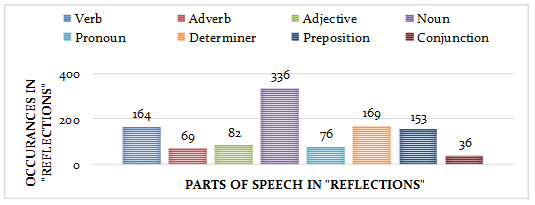
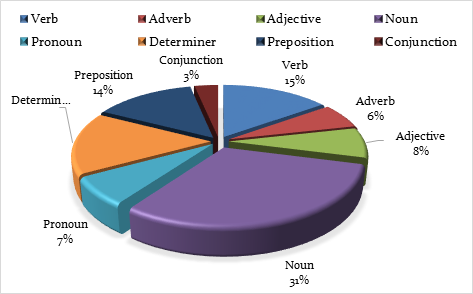
Figure 1: parts of speech

parts of speech percentage

Morphological Level
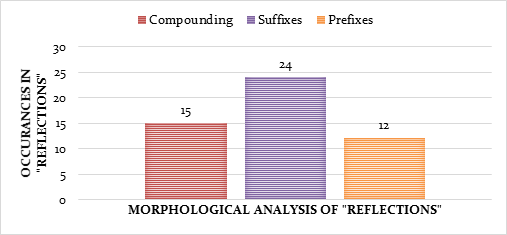
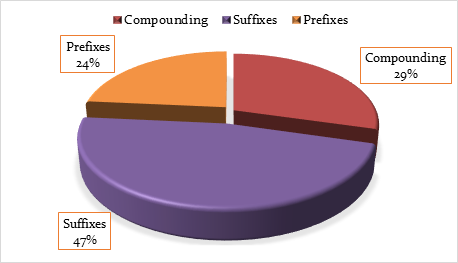
Figure 3: Compounding and affixes

Compounding and affixes percentage

Phonological Level
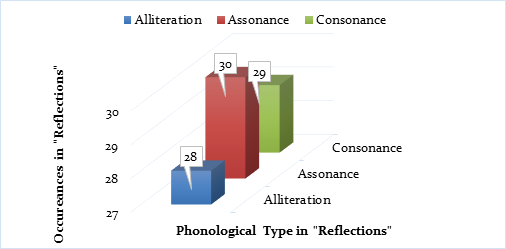
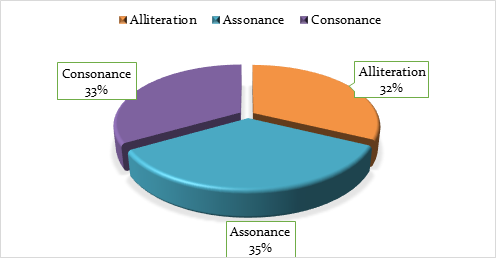
Phonological level deal with those letters of words which create rhymed shape of something and also study sound devices such as alliteration, consonance and assonance in poetry or verses.
Rhyme scheme
There is no proper rhyme scheme
Sound Devices
Alliteration, consonance, Assonance
Sound Devices

Sound devices percentage

Discussion
Lexical Level
>In this level we look to the individual words such as verb, adverb, noun, pronoun, adjective, preposition, determiner and idioms tend to pattern in different linguistics context / in the poem;
>Table 1 class="PlainTable21" border="0" cellspacing="0" cellpadding="0" align="left" width="532">
Noun
width="146" valign="top">Noun
width="172" valign="top">Noun
Spell
width="146" valign="top">Water
width="172" valign="top">Monstrous
Monsoon shower
width="146" valign="top">Sand
width="172" valign="top">Self
Noun
width="146" valign="top">Noun
width="172" valign="top">Noun
Air
width="146" valign="top">Landscape
width="172" valign="top">Hail
Thing
width="146" valign="top">Snipe
width="172" valign="top">History
Poet
width="146" valign="top">Anonymity
width="172" valign="top">Logic
Dreams
width="146" valign="top">Emotion
width="172" valign="top">Monument
Time
width="146" valign="top">Flesh
width="172" valign="top">Stone
Action
width="146" valign="top">Blood
width="172" valign="top">Soldier
Means
width="146" valign="top">State
width="172" valign="top">Fungus
Words
width="146" valign="top">Mind
width="172" valign="top">Slum
Responsible
width="146" valign="top">Tone
width="172" valign="top">Children
Articulate
width="146" valign="top">Artist
width="172" valign="top">Chalk
Phrases
width="146" valign="top">Vision
width="172" valign="top">Stumps
Hands
width="146" valign="top">Choice
width="172" valign="top">Base
Gyre
width="146" valign="top">Summer
width="172" valign="top">Day
Poems
width="146" valign="top">Grunts
width="172" valign="top">Statue
Space
width="146" valign="top">Gestures
width="172" valign="top">Knuckle
Tensions
width="146" valign="top">Cloths
width="172" valign="top">Hangnail
Repetitive
width="146" valign="top">Identity
width="172" valign="top">Phrase
Adequacy
width="146" valign="top">Bone
width="172" valign="top">Line
Saffron
width="146" valign="top">Autumn
width="172" valign="top">Moulders
Apprehension
width="146" valign="top">Skull
width="172" valign="top">Eyes
Pilgrimage
width="146" valign="top">Migratory
width="172" valign="top">Proof
Man
width="146" valign="top">Garden
width="172" valign="top">Cunning
Harmony
width="146" valign="top">Overtones
width="172" valign="top">Skill
Fluke
width="146" valign="top">Bulbuls
width="172" valign="top">Edifice
Eel
width="146" valign="top">Empurpled
width="172" valign="top">Arch
Way
width="146" valign="top">Objects
width="172" valign="top">Heart
Brooding
width="146" valign="top">Reasons
width="172" valign="top">Marble
Pattern
width="146" valign="top">Tentative
width="172" valign="top">Veins
Impossible
width="146" valign="top">Existence
width="172" valign="top">Nature
Evasion
width="146" valign="top">Tree
width="172" valign="top">Permanence
Definitions
width="146" valign="top">Chain
width="172" valign="top">Multiples
Mercy
width="146" valign="top">Thought
width="172" valign="top">Autumn
Luck
width="146" valign="top">Numerous
width="172" valign="top">Sorts
Element
width="146" valign="top">Laburnum
width="172" valign="top">Hills
Technique
width="146" valign="top">Seasons
width="172" valign="top">Path
Substance
width="146" valign="top">Medicinal
width="172" valign="top">Guts
Permanent
width="146" valign="top">Lamps
width="172" valign="top">Pain
Noun
width="175" valign="top">Noun
width="179" valign="top">Noun
Puissance
width="175" valign="top">Meadow
width="179" valign="top">Orchard
Affla
width="175" valign="top">Cliff
width="179" valign="top">Book
Craft
width="175" valign="top">Lips
width="179" valign="top">Tower
Novice
width="175" valign="top">Sky
width="179" valign="top">Tangle
Abandonment
width="175" valign="top">Madhouse
width="179" valign="top">Grass
Thrill
width="175" valign="top">Ogre
width="179" valign="top">Sands
Oasis
width="175" valign="top">Giant
width="179" valign="top">Order
Waste
width="175" valign="top">Wraith
width="179" valign="top">Usage
Building
width="175" valign="top">Brook’s serenity
width="179" valign="top">Renewal
Brick
width="175" valign="top">Angels
width="179" valign="top">Revalidation
Place
width="175" valign="top">Leaves
width="179" valign="top">Slogans
Lyric sulk
width="175" valign="top">Spring
width="179" valign="top">Criterion
Risk
width="175" valign="top">God
width="179" valign="top">Ancestor
Stammer
width="175" valign="top">Harvest
width="179" valign="top">Sons
Rebel
width="175" valign="top">Moon
width="179" valign="top">Paradox
Decline
width="175" valign="top">Goddess
width="179" valign="top">Hell
Path
width="175" valign="top">Heirs
width="179" valign="top">Plural
Purpose
width="175" valign="top">Snipers nest
width="179" valign="top">Miracle
Contentment
width="175" valign="top">Jet
width="179" valign="top">Context
Garden
width="175" valign="top">Cultures
width="179" valign="top">Situation
Relevance
width="175" valign="top">Hong Kong
width="179" valign="top">Carnage
Myths
width="175" valign="top">San Francisco
width="179" valign="top">Wake
Herons
width="175" valign="top">Orchard
width="179" valign="top">Love
Pool
width="175" valign="top">Theme
width="179" valign="top">War
Porcelain
width="175" valign="top">Ramayana
width="179" valign="top">
Figurines
width="175" valign="top">Astronaut
width="179" valign="top">
Mind
width="175" valign="top">Hymn
width="179" valign="top">
Force
width="175" valign="top">Concern
width="179" valign="top">
Wind
width="175" valign="top">Frond’s confines
width="179" valign="top">
Glacier
width="175" valign="top">Banners
width="179" valign="top">
Leaf
width="175" valign="top">Lobes
width="179" valign="top">
Landscape
width="175" valign="top">Wind
width="179" valign="top">
Facts
width="175" valign="top">Caravans
width="179" valign="top">
Mountain
width="175" valign="top">Neem’s tomorrow
width="179" valign="top">
Observation
width="175" valign="top">Caveman
width="179" valign="top">
Entanglements
width="175" valign="top">Brontosaurus
width="179" valign="top">
Bird
width="175" valign="top">Mushroom
width="179" valign="top">
Destroyer
width="175" valign="top">Growth
width="179" valign="top">
Predecessors
width="175" valign="top">Microcosm
width="179" valign="top">
Adverb
width="127" valign="top">Adverb
width="183" valign="top">Preposition
width="168" valign="top">Pronoun
Over
width="127" valign="top">Still
width="183" valign="top">In
width="168" valign="top">It
Only
width="127" valign="top">More
width="183" valign="top">From
width="168" valign="top">I
Already
width="127" valign="top">Never
width="183" valign="top">For
width="168" valign="top">His
Too
width="127" valign="top">Gently
width="183" valign="top">To
width="168" valign="top">My
Here
width="127" valign="top">Finally
width="183" valign="top">On
width="168" valign="top">They
Again
width="127" valign="top">When
width="183" valign="top">As
width="168" valign="top">Me
Willingly
width="127" valign="top">Then
width="183" valign="top">With
width="168" valign="top">Its
Before
width="127" valign="top">There
width="183" valign="top">Before
width="168" valign="top">He
So
width="127" valign="top">Yet
width="183" valign="top">At
width="168" valign="top">Them
When
width="127" valign="top">Forever
width="183" valign="top">By
width="168" valign="top">You
Quickly
width="127" valign="top">Too
width="183" valign="top">Without
width="168" valign="top">Us
There
width="127" valign="top">Back
width="183" valign="top">Into
width="168" valign="top">Our
Now
width="127" valign="top">Really
width="183" valign="top">Like
width="168" valign="top">Who
Aside
width="127" valign="top">Close
width="183" valign="top">Till
width="168" valign="top">What
Casually
width="127" valign="top">Perhaps
width="183" valign="top">Of
width="168" valign="top">Their
Yet
width="127" valign="top">Here
width="183" valign="top">width="168" valign="top">
Him
Always
width="127" valign="top">Once
width="183" valign="top">width="168" valign="top">
We
Once
width="127" valign="top">As well
width="183" valign="top">width="168" valign="top">
Their
Blindly
width="127" valign="top">Even
width="183" valign="top">width="168" valign="top">
Whose
Anew
width="127" valign="top">Enough
width="183" valign="top">width="168" valign="top">
Itself
Then
width="127" valign="top">width="183" valign="top">
width="168" valign="top">
Ourselves
How
width="127" valign="top">width="183" valign="top">
width="168" valign="top">
Still
width="127" valign="top">width="183" valign="top">
width="168" valign="top">
While
Bravely
width="127" valign="top">width="183" valign="top">
width="168" valign="top">
Against
Meanwhile
width="127" valign="top">width="183" valign="top">
width="168" valign="top">
Outside
Quietly
width="127" valign="top">width="183" valign="top">
width="168" valign="top">
Under
Not
width="127" valign="top">width="183" valign="top">
width="168" valign="top">
Between
Away
width="127" valign="top">width="183" valign="top">
width="168" valign="top">
Though
Then
width="127" valign="top">width="183" valign="top">
width="168" valign="top">
Because
How
width="127" valign="top">width="183" valign="top">
width="168" valign="top">
If
Ago
width="127" valign="top">width="183" valign="top">
width="168" valign="top">
Through
Not
width="127" valign="top">width="183" valign="top">
width="168" valign="top">
Adjective
width="179" valign="top">Adjective
width="170" valign="top">Adjective
Long dry
width="179" valign="top">Dumb
width="170" valign="top">Proper
Last
width="179" valign="top">New
width="170" valign="top">Real
Fierce
width="179" valign="top">External
width="170" valign="top">Adult
New
width="179" valign="top">Own
width="170" valign="top">Formal
White
width="179" valign="top">Barren
width="170" valign="top">Inevitable
First
width="179" valign="top">Bland
width="170" valign="top">Cool
Second
width="179" valign="top">Same
width="170" valign="top">Original
Rounded
width="179" valign="top">Vertical
width="170" valign="top">Imaginary
Cool
width="179" valign="top">Essential
width="170" valign="top">Scrubby
Startled
width="179" valign="top">Same
width="170" valign="top">Native
Earlier
width="179" valign="top">Vertical
width="170" valign="top">Dark
Real
width="179" valign="top">Essential
width="170" valign="top">Banyan
Green
width="179" valign="top">Such
width="170" valign="top">Hairy
True
width="179" valign="top">Recent
width="170" valign="top">Shrill
Primitive
width="179" valign="top">Casual
width="170" valign="top">Own
Older
width="179" valign="top">Conscious
width="170" valign="top">Fertile
Equal
width="179" valign="top">Intense
width="170" valign="top">Latest
Red
width="179" valign="top">Illogical
width="170" valign="top">Ample
Arsed
width="179" valign="top">Such
width="170" valign="top">Varied,
width="179" valign="top">
Such
width="170" valign="top">Splendid
Determiner
width="178" valign="top">Determiner
width="172" valign="top">Conjunction
Above
width="178" valign="top">Every
width="172" valign="top">And
While
width="178" valign="top">Some
width="172" valign="top">Or
Among
width="178" valign="top">A
width="172" valign="top">But
After
width="178" valign="top">An
width="172" valign="top">Coma
Across
width="178" valign="top">Half
width="172" valign="top">
Beneath
width="178" valign="top">That
width="172" valign="top">
Before
width="178" valign="top">Those
width="172" valign="top">
The
width="178" valign="top">Each
width="172" valign="top">
There
width="178" valign="top">Whatever
width="172" valign="top">
This
width="178" valign="top">No
width="172" valign="top">
Which
width="178" valign="top">Another
width="172" valign="top">
Verb
width="181" valign="top">Verb
width="170" valign="top">Verb
Ended
width="181" valign="top">Plummets
width="170" valign="top">Follow
Receive
width="181" valign="top">Were meant
width="170" valign="top">Swing
Turn
width="181" valign="top">Convey
width="170" valign="top">Conscripted
Living
width="181" valign="top">Keep
width="170" valign="top">Love
Responds
width="181" valign="top">Lives
width="170" valign="top">Crowned
Wakes
width="181" valign="top">Dies
width="170" valign="top">Bowed
Find
width="181" valign="top">Persuaded
width="170" valign="top">Need
Tumbling
width="181" valign="top">Wear
width="170" valign="top">Sculptured
Come
width="181" valign="top">Hides
width="170" valign="top">Guards
Be cooped
width="181" valign="top">Loses
width="170" valign="top">Accumulates
Feel
width="181" valign="top">Caricature
width="170" valign="top">Prepares
Teased
width="181" valign="top">Will endure
width="170" valign="top">Will be gone
Start
width="181" valign="top">Conceived
width="170" valign="top">Remains
Must
width="181" valign="top">Grow
width="170" valign="top">Pressured
Waste
width="181" valign="top">Try
width="170" valign="top">Moulders
Can say
width="181" valign="top">Pare
width="170" valign="top">Survives
Want
width="181" valign="top">Struck
width="170" valign="top">Noted
Will see
width="181" valign="top">Sit
width="170" valign="top">Glinted
Hinted
width="181" valign="top">Listen
width="170" valign="top">Falls
Winking
width="181" valign="top">Inject
width="170" valign="top">Lies
Can be
width="181" valign="top">Improvise
width="170" valign="top">Examine
Made
width="181" valign="top">Adorn
width="170" valign="top">Lavishes
Must be faced
width="181" valign="top">Use
width="170" valign="top">Buried
Flows
width="181" valign="top">Provide
width="170" valign="top">Chose
Wrenched
width="181" valign="top">Survive
width="170" valign="top">Wonder
Consider
width="181" valign="top">Changed
width="170" valign="top">Rested
Study
width="181" valign="top">Becomes
width="170" valign="top">Hunted
Co-exist
width="181" valign="top">Founded
width="170" valign="top">Plunged
Let
width="181" valign="top">Will roost
width="170" valign="top">Will bloom
Proceed
width="181" valign="top">Slouched
width="170" valign="top">Will cringe
Engrafted
width="181" valign="top">Became
width="170" valign="top">Dried
Glows
width="181" valign="top">Were spawned
width="170" valign="top">Blown
Impugn
width="181" valign="top">Smiled
width="170" valign="top">Assemble
Withdraw
width="181" valign="top">Requisitioned
width="170" valign="top">Give
Seek
width="181" valign="top">Fashioned
width="170" valign="top">Meant
Leave
width="181" valign="top">Ruined
width="170" valign="top">Are steeped
Remains
width="181" valign="top">Must find
width="170" valign="top">Are rooted
Explore
width="181" valign="top">Drone
width="170" valign="top">Contend
Brings
width="181" valign="top">Pollinates
width="170" valign="top">Lisping
Sunders
width="181" valign="top">Inherit
width="170" valign="top">Are faced
Crams
width="181" valign="top">Lived
width="170" valign="top">Throbs
Created
width="181" valign="top">Pressed
width="170" valign="top">Die
TRIGGERS
width="181" valign="top">Cleared
width="170" valign="top">Start
I have three words selected form every parts of speech of Taufiq Rafat poem Reflection for elaboration such as noun, verb, adverb, adjective, conjunction, preposition and determiner etc.
Noun
There are 316 nouns in this poem writer his used 316 different names of things. But the researcher has elaborate or explain only three of them such as Monsoon shower, Dumb tree, Myths
Monsoon Shower
Monsoon shower in Reflections author writes word noun in first stanza and in 3rd line of stanza. But now the researcher goes to evaluate this words that the writer meaning of this words. Monsoon shower refer to that when paddy fields receive the monsoon shower then they start action because this monsoon shower response to every living things and also respond to poet too. Because after that poet wake up and start the action then he able to writes to present something new. The main reason was that the energy already present in the air.
Dumb Tree
The author used this noun in four stanzas and in four line of stanza. Here the researcher describe that the word refer to what? The Dumb tree means nothing like that mean no fruits, no one like it because this tree no longer importance but when the red-arsed bulbuls inject the tree then this tree become valuable with life . Its mean something is really important in our life.
Myths
The writer writes this noun in stanza eight in second lines. Now the researcher goes toward this noun to find to describe the meaning of the writer in this stanza. Myth common meaning to explain some natural phenomena, those story in which people believe or not but here in this stanza the researcher elaborate this the relationship among the myth that what links between two myths if we look to the stanza 8 in this stanza the author compare herons with porcelain figurines in this stanza myth like that the herons live like but now the herons life become changed and it change forever. Myth stand on earth like mountain but if we look after many time this myth become fact become to nature. This facts we found after observation this myth become to reality but the author continue this word still to another stanza means in 9 stanza the author say that the myths create by poets but there in second the author also said that the poet have also this capability to destroy it.
Verb
Those word which show the action of something or someone which convey the state of existence or event. In the poem Reflections the poet used 164 words of verb but the researcher explain only three of them such as teased, convey, inject etc.
Teased Used As A Verb In The Poem Reflection
A rightness, an adequacy
This teased me with its nearness before.
Rafat say that in the first stanza that this teased me, teased mean irritate but the researcher go to explain that what the meaning is of teased in the poem. Teased mean was that in the poem the poet says the words become more powerful towards me for the action, presenting or writing. Every word want to pin down at the paper they want to shape, to articulate because of this the poet say the words become more heavy and make me teased .
Another Word Convey Which Used As Verb In The Poem Reflection
Convey means to present something, to say something. The work of words was that to convey the emotion of someone, to express the feeling of someone. But the poet says that the words die before to convey.
Inject Is A Verb Which Used In The Poem Reflection
Inject means to give something to someone the researcher evaluate the meaning with the respect of poem that red-arsed bulbul come and inject the dumb tree and give him life.
Adverb
A term or idiom that changes or succeeds the category an adjective, verb or a word group, expressing a connection of place, time, manner . Adverb which used Rafat in his poem are more but the researcher selects only three of them for the discussion such as casually, meanwhile, quickly.
Casually As Adverb In The Rafat Poem Reflection
Casually means without commitment or permanence’s; occasionally or irregularly . In the poem, the writer has used this word for the unintended inclusion of thoughts, ideas and words in the poem.
Meanwhile As Another Adverb In Reflection
In poem its mean at the same time poet say that the words like monument because the words are memorable things in any tens.
Quickly the Third One Adverb in the Poem Reflection
Quickly means rapidly the author write in the poem that some person are more intelligent and gain the things quickly they born by birth. But some people they try to gain the valuable things for the success.
Adjective
Adjective are those words which show the quality or quantity of someone or something. The writer present more adjective in his poem Reflection but the researcher takes only three of them for the explanation such as green, conscious, original.
The tone of green
An artist sees in the turning light (stanza 3)
Can afflatus co-exist?
With conscious craft? As a novice (stanza 7)
The original freshness of vision
Now herons are changed forever (stanza 8)
Conjunction in the Poem Reflection
Conjunctions are those words which the writer used for the connection of two or more ideas such as and, coma, or etc.
Preposition
Preposition are those words which the writer take first of noun, pronoun to express the direction, place, time etc.to define object the pronoun which used in the poem Reflection by Taufiq Rafat such as from, before, without etc.
Pronoun
Those words which the writer used for the
noun but for those noun which has previously cited. Taufiq Rafat writes pronoun many time in his poem such as he, it, they, his, him etc.
Determiner
In grammar those words which the author write first of noun means in the start of noun Rafat used many time such as above, while, among, a, an, that those, each etc.
Morphological Level
In this level the researcher describe the category of words in the poem such as compounding and affixes in this level the researcher also describe the words that how many morphemes used in words.
>Table 7. Compounding and affixes class="TableGrid9" border="0" cellspacing="0" cellpadding="0">
Compounding
width="102" valign="top">Suffixes
width="142" valign="top">Suffixes
width="142" valign="top">Preffixes
Paddy fields
width="102" valign="top">Twisting
width="142" valign="top">width="142" valign="top">
Irreplaceable
Monsoon shower
width="102" valign="top">Wrenched
width="142" valign="top">waiting
width="142" valign="top">Outstretched
Lifetime
width="102" valign="top">Saturated
width="142" valign="top">gladness
width="142" valign="top">Indestructible
Kingfishers wings
width="102" valign="top">Learning
width="142" valign="top">Doodling’s
width="142" valign="top">Uneasy
Cross-road
width="102" valign="top">Building
width="142" valign="top">tightening
width="142" valign="top">Untrue
Sunlight
width="102" valign="top">Wilderness
width="142" valign="top">rightness
width="142" valign="top">Unconnected
Headstone
width="102" valign="top">Suffered
width="142" valign="top">nearness
width="142" valign="top">Anything
Pine smell
width="102" valign="top">Stillness
width="142" valign="top">needed
width="142" valign="top">Microcosm
Rice fields
width="102" valign="top">Freshness
width="142" valign="top">nakedness
width="142" valign="top">Rekindle
Goat track
width="102" valign="top">Comeliness
width="142" valign="top">leafiness
width="142" valign="top">Ourselves
Gul-mohar
width="102" valign="top">Punishing
width="142" valign="top">beginning
width="142" valign="top">Became
Everyday shisham
width="102" valign="top">Rooted
width="142" valign="top">learning
width="142" valign="top">Empurple
Volcano heaves
width="102" valign="top">Lisping
width="142" valign="top">reckoning
width="142" valign="top">
Caveman
width="102" valign="top">width="142" valign="top">
extracted
width="142" valign="top">
width="102" valign="top">
width="142" valign="top">
goodness
width="142" valign="top">
width="102" valign="top">
width="142" valign="top">
Feeling
width="142" valign="top">
Compounding in Taufiq Rafat poem Reflection
>Compounding is the connection of two or more unconnected words to arrange a single term. Those compounding words which use in the poem Reflection are following .Lifetime, rice fields, pine-smell, sunlight, paddy fields, goat track, everyday shisham etc. > >Affixes in Taufiq Rafat poem Reflection
>The poem reflection contains of suffixes and prefixes. But the poem richly involves of suffixes. Affixes are free and bond morpheme which make the word proper according to the context. Suffixes that morpheme which we enhance in the last of words and prefixes that morpheme which we add in the start of words. Those affixes which use in the poem are following> >Suffixes such as ing ,es , ed, ness etc.
> Wrenched freshness >Twisting stillness>Saturated comeliness>Learning punishing>Building >Wilderness> >Prefixes such as un, miss, any, re
>Irreplaceable unconnected >Outstretched anything>Indestructible microcosm>Uneasy rekindle>Untrue ourselves etc.> >Phonological Level
>Now this piece of term paper, the researcher >has evaluated phonological level of linguistic. In phonological level, letter of sound which create rhyming scheme. There is repetition of different sounds in words, phrases, and sentence. The phonological level involves Alliteration, consonance, Assonance the repetition of same sound in the start of words, phrases and sentences we named Alliteration, the repetition of parallel consonant sound in the end of words in phrase or sentence then we called consonance and the usage of equal vowel sound in words in a line is we called Assonance sound.> >Rhyming Scheme
>The poem Reflection consists on eleven stanzas and each stanza is twenty two lines long but last one divided into twenty four lines with has no rhymed shape because the ending point of each stanza line different form one another . Therefore we say that this poem Reflection is imperfect rhyming scheme because there is no identically or similar rhyme scheme because of this we say that in this poem is no rhyming scheme.
>Table 8. Sound Devices class="TableGrid9" border="0" cellspacing="0" cellpadding="0">
Alliteration
width="213" valign="top">Consonance
width="213" valign="top">Assonance
Dreams , doodling
width="213" valign="top">Living thing
width="213" valign="top">Monsoon showers
The , time
width="213" valign="top">Dreams doodling’s
width="213" valign="top">Fierce , gladness
With, words
width="213" valign="top">Means words
width="213" valign="top">Living thing
Till , the
width="213" valign="top">Fluke, look
width="213" valign="top">Action, for
Startled, snipe
width="213" valign="top">Rightness, nearness
width="213" valign="top">Action, for
Then , the
width="213" valign="top">Saffron, apprehension
width="213" valign="top">Articulate, again
He , has
width="213" valign="top">Harmony, quickly
width="213" valign="top">Tightening, gyre
Hide , his
width="213" valign="top">Rounded, hinted
width="213" valign="top">First, time
Who , will
width="213" valign="top">Our, air
width="213" valign="top">Rightness, adequacy
Try , to
width="213" valign="top">Mercy, only
width="213" valign="top">Nearness, before
Then , to
width="213" valign="top">Hone, technique
width="213" valign="top">Saffron, apprehension
Whatever , we
width="213" valign="top">Blood, mind
width="213" valign="top">Waste, half
Cities , crows
width="213" valign="top">Caricature, endure
width="213" valign="top">Million words
Children , chalk
width="213" valign="top">Cloths, nakedness
width="213" valign="top">Rounded, pattern
Skill , survives
width="213" valign="top">Equal, skull
width="213" valign="top">Hinted, winking
Thoughts , the
width="213" valign="top">Beginning, learning
width="213" valign="top">Evasion, now
Conscious , craft
width="213" valign="top">Brooding, tree
width="213" valign="top">Responsible, air
Poem , proceed
width="213" valign="top">Swing, reckoning
width="213" valign="top">Hone, technique
Shall , such
width="213" valign="top">Guards, cross-roads
width="213" valign="top">Craft, substance
Gently , glow
width="213" valign="top">Cities, crowds
width="213" valign="top">Earlier, emotion
Gul-mohar, glows
width="213" valign="top">Stumps, base
width="213" valign="top">Turning light
Proper , place
width="213" valign="top">Knuckle, hangnail
width="213" valign="top">Artist, vision
Such , shrill
width="213" valign="top">Guts, puissance
width="213" valign="top">Repetitive, illusion
Wraith , were
width="213" valign="top">Co-exist, craft
width="213" valign="top">Grunts and gestures
Hunted, here
width="213" valign="top">Novice, intense
width="213" valign="top">Grow older
That, they
width="213" valign="top">Building, learning
width="213" valign="top">Autumn, struck
This, then
width="213" valign="top">Adult, contentment
width="213" valign="top">Red-arsed, come
Through, the
width="213" valign="top">Relevance, myths
width="213" valign="top">Beginning, while
width="213" valign="top">
Herons, brings, figurines
width="213" valign="top">Extracted , whatever
width="213" valign="top">
Imaginary, scrubby
width="213" valign="top">History , logic
Conssonance
width="319" valign="top">Assonance
Myths, poets
width="319" valign="top">Poem, monument
Lips, madhouse
width="319" valign="top">Long, stone
Fashioned, god
width="319" valign="top">Accumulates, fungus
Hong, Kong
width="319" valign="top">Quietly, prepare
Hymn, moon
width="319" valign="top">Vertical. Line
Lobes, close
width="319" valign="top">Headstones, heart
Bloom, mushroom
width="319" valign="top">Nature, permanence
Grass, across
width="319" valign="top">Saturated, pine-smell
width="319" valign="top">
Buried, under
width="319" valign="top">
Study, casual
width="319" valign="top">
Every day, shisham
width="319" valign="top">
Sulk, impugn
width="319" valign="top">
Finally, withdraw
Alliteration in Taufiq Rafat’s Reflection
Alliteration is the reappearance of same sound in the lines of the poetry. Alliteration used is artistic point of view by Taufiq Rafat in his chosen poems. Because Taufiq Rafat want attention of his reader and listener therefore the alliteration also used for the attention of listener and reader .it make the poem to highlight his sentences. It creates attractive effect for reader and listener they also fulfil the poems or verses outstanding
because they provide tuneful influence.
>Alliteration in Rafat’s Reflection
Rafat uses alliteration in his long and complicated poems Reflection; it is the significant in a deeply personal way of Rafat. In this poem alliteration are such as following:
Dreams, doodling’s (stanza 1st line 9)
Children, chalk (stanza 5th line 8)
Gul-mohar, glows (stanza 7th line 10)
Wraith, were (stanza 9th line 9)
Consonance in Taufiq Rafat’s Reflection
Consonance is the repetition of consonant sound in the end of words in phrase, sentences of the poetry or verses. Rafat used alliteration in his all famous and complex poems such as kitchen, monsoon, reflection etc. Consonance creates pleasant affect and makes a expressive sense in poetry. We can openly see consonance in the poem i.e. the repetition of consonant sound g in Living and thing (stanza 1st line 7).In the second stanza in line 5 and 6 of the poem consonant sound y in word Harmony and quickly. Therefore in 5th stanza line 5 s sounds in words guards and cross-roads .Similarly in stanza 8 in 2nd sentence s in words herons and figurines.
Assonance in the poem of Rafat Reflection
Assonance is the repetition of similar vowel sound in the lines of poem. Assonance arises in that time in the poem when we see the repetition of same vowel sound in line of stanza. We can find the example of assonance sound in the poem of Rafat Reflection. The vowel sound in stanza 1st and in 3rd line of the poem o in words monsoon and showers. Another example of assonance sound i in 32 line of the poem in words hinted and winking. Then another vowel sound is u in words grunts and gestures in line 59 of the poem. Vowel sound a in words extracted and whatever (line 89).
Conclusion
Through Stylistic Analysis we get information about the poems of Taufiq Rafat Reflection. Reflection is considered on imagination, nature, and more than more on symbolism. In Stylistic we study Style. Style is the manner of man. Style play important role in various Level of linguistics. These Level reliefs the learner to explain and recognize the literary term in words, phrase, and sentence in a suitable style. The researcher main focuses on three Levels of linguistics. Lexical Level, Morphological Level, and Phonological Level, in Lexical Level the researcher focus on parts of speech, in Morphological Level describe the compounding and affixes (prefixes, suffixes) and in Phonological Level the researcher discuss sound devices with the respect of alliteration, assonance, consonance and rhyme scheme. The Reflection poems of Taufiq Rafat are elaborate with the help of Stylistic Levels of linguistics. Reflection is the poet is extremely by the beautiful sight of nature. The poem Reflection is more fulfilling a desire in conception and appearances. This poetry also show that Rafat’s interest all the romantic quality-love of nature, beauty and imagination
References
- Ali, H., Bhatti, I. A., & Shah, A. H. (2016). Stylistics Analysis of the Poem―Hope is The Thing with FeathersÇ. World Journal of Research and Review (WJRR), 3(5), 18-21.
- Batool, Z., Kiran, S., & Azhar, M. A. (2016). Stylistic analysis of William wordsworth’s poem ‘daffodils.’ International Journal of Basic and Applied Sciences, 5(2), 95
- Jaafar, E. A. (2014). A stylistic analysis of Bisson’s bears discover fire. Journal of the College of Education for Women, 25(4).
- Khan, A. B., & Jabeen, T. (2015). Stylistics analysis of the poem “Ode To Autumn†by John Keats. International Journal of Academic Research and Reflection, 3(1), 127-137.
- Khan, A. B., Summara, R., & Saddique, G. (2014). Stylistic Analysis of the poem “ONSET†by Robert Frost. International Journal of Academic Research and Reflection, 2(4), 121-126.
- Kumar, K. (1987). Conducting group interviews in developing countries (Vol. 8). Washington, DC: US Agency for International Development.
- Leech, G. N., & Short, M. (2007). Style in fiction: A linguistic introduction to English fictional prose (No. 13). Pearson Education.
- Mahmood, R., & Jamil, A. (2015). Stylistics Analysis of Holly Thursday I by William Blake. International Journal of English Language and Linguistics Research, 3(6), 46-52.
- Max, J. I. S. D. (2020). Stylistic analysis on Roald dahl’s poem Television. Calls (Journal of Culture, Arts, Literature, and Linguistics), 6(1), 109-122.
- Mode, M, A, (2015). The ABC of stylistics: A preliminary investigation. International journal of humanities and social science invention. 4(10), 13-17
- Naseer, M, (2018). A study of stylistic deviation in Maya Anglelu’s women work. Al, Ustath, 3(4),85-99.
- Putri, A. (2018). Stylistic analysis of the poem “During Wind and Rain†by Thomas Hardy. Anglo-saxon: Journal of the English Language Education Study Program, 9(2), 169-182.
- Roona, M., Ghazanfar, S., & Maqbool, S. (2022). Stylistic analysis of Daud Kamal’s poem The street of nightingale. Jahan-e- Tahqeeq, 5(1), 204-218.
- Simpson, P. (1997). Language through literature (pp. 2-7). London: Routledge.
- Tariq, M.(2018). Style, stylistics and stylistic analysis: a re-evaluation of the modern- day rhetoric’s of literary discourse. International journal of English research, 4(2). 46-50.
- Verdonk, P. (2002). Stylistics. Oxford University Press.
- Widdowson, H. G. (2014). Stylistics and the Teaching of Literature. Routledge.
Cite this article
-
APA : Ayaz, Z., Ali, S., & Nazish. (2022). A Stylistics Analysis of Taufiq Rafat's Reflection. Global Language Review, VII(III), 133-153. https://doi.org/10.31703/glr.2022(VII-III).12
-
CHICAGO : Ayaz, Zaheena, Sardar Ali, and Nazish. 2022. "A Stylistics Analysis of Taufiq Rafat's Reflection." Global Language Review, VII (III): 133-153 doi: 10.31703/glr.2022(VII-III).12
-
HARVARD : AYAZ, Z., ALI, S. & NAZISH. 2022. A Stylistics Analysis of Taufiq Rafat's Reflection. Global Language Review, VII, 133-153.
-
MHRA : Ayaz, Zaheena, Sardar Ali, and Nazish. 2022. "A Stylistics Analysis of Taufiq Rafat's Reflection." Global Language Review, VII: 133-153
-
MLA : Ayaz, Zaheena, Sardar Ali, and Nazish. "A Stylistics Analysis of Taufiq Rafat's Reflection." Global Language Review, VII.III (2022): 133-153 Print.
-
OXFORD : Ayaz, Zaheena, Ali, Sardar, and Nazish, (2022), "A Stylistics Analysis of Taufiq Rafat's Reflection", Global Language Review, VII (III), 133-153
-
TURABIAN : Ayaz, Zaheena, Sardar Ali, and Nazish. "A Stylistics Analysis of Taufiq Rafat's Reflection." Global Language Review VII, no. III (2022): 133-153. https://doi.org/10.31703/glr.2022(VII-III).12